 Google Maps
Finding Magic on the Road
TL;DR
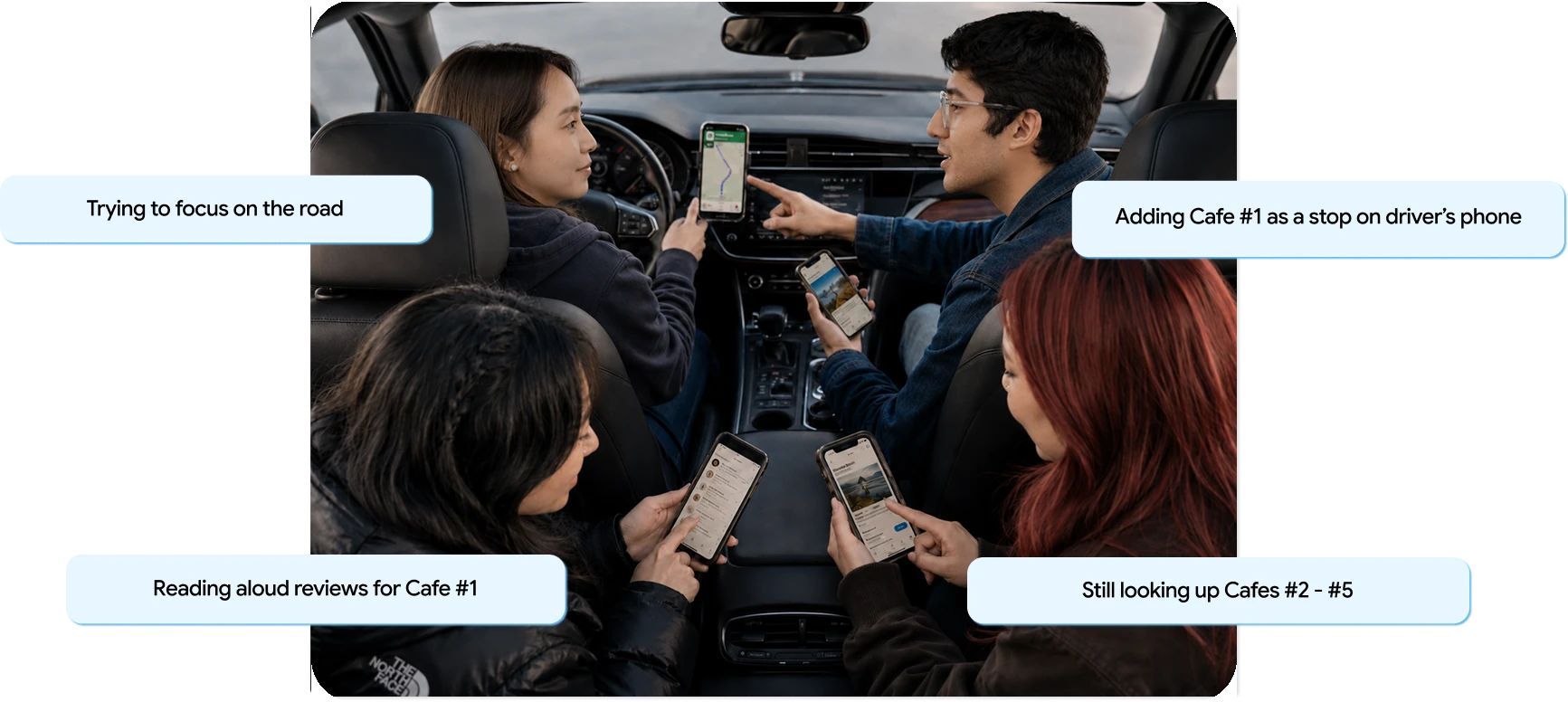
Google Maps is built for a single driver, but a road trip with friends means accommodating the entire car. Finding stops, agreeing on where to go, and adding them to the route all pile onto the driver’s phone—and the stress snowballs quickly. Despite this, Gen Z travelers are intentional about experiencing the journey, and would rather chase spontaneous detours and curate their own memories than leave decision-making up to AI.
We designed two connected experiences for Google Maps. Road Trip Jam lets the whole car plan and discover together while Gemini quietly handles the logistics, and Road Trip Wrapped turns each person’s favorite moments into a playful shareable recap.
I worked across research, ideation, and design, driving storyboarding for the end-to-end experience and leading the build for Road Trip Wrapped, from first concept to working prototype.
Background
Today’s tools aren’t built for how friends actually travel.
Road trips with friends are fluid, shared social experiences, but current navigation and planning apps struggle to help a group realign when plans change. Google Maps partnered with our capstone team to explore how Gemini could make that experience more “magical.”
Google was also especially curious about how road trippers ages 18 to 24 travel. We saw the most room for connection and magic in group trips taken for fun rather than to reach a destination.
Problem
OK Google… what exactly is “magic”?
The brief hinged on a word none of us could define.
Half of us thought “magic” meant spontaneous detours, and I kept redirecting the conversation toward the people you share them with. But none of us were sure how much of that magic AI could—or should—create.
Research
Where magic begins and ends
- 9 semi-structured interviews
- Young adults age 18–24 who had taken a journey-focused U.S. road trip within the past 3 months. Led 5/9 interviews.
- 1 SME interview
- Google Maps power user / travel influencer with 500K+ followers.
- 2 team road trips
- Autoethnographic research.
We set out to learn what “magic” actually meant to travelers, as well as what obstacles kept getting in the way. Since little frustrations rarely make it into the post-trip recap, we also took two road trips of our own to keep those bumps in the road fresh in our memory.
“Deep down, I felt like it wasn’t me doing it… [Finding it yourself] feels rewarding because you’re like, oh, wow. It was meant to be.”
Key insights
- Insight #1
Maps treats the car as a single user, when it’s really a group.
The driver’s phone is the control tower, but decisions happen on everyone’s phones.
- Insight #2
AI is trusted for logistics, not taste.
A worthwhile recommendation needs lived experience to back it up.
- Insight #3
The best discoveries feel earned.
The greatest highs come from stops nobody planned, especially ones you find yourself.
- Insight #4
Reliving the trip is part of the trip.
Gen Z values curating their own versions of the trip to keep and share.
With these insights, we could sense we were getting closer, but the team grew increasingly frustrated that we still couldn’t confidently answer the question, “What is magic?”
That changed near the end of one interview, when I asked a participant what mattered more to them: spontaneous moments, or human connection.
Their answer settled our debate for good, and became our framework for finding magic on the road:
“Spontaneity is fun to look back on, but the connection is the thing that I’m carrying and feel even now. … The magical moments are the sprinkles. The connections you build with the people you’re with—that’s the ice cream.”
The ice cream cone — a framework for road trip magic
SprinklesSpontaneous discovery
Ice creamHuman connection
ConeSupport & alignment
Turned out, spontaneity and connection were two layers of the same thing—and they both needed something sturdy underneath. That reframed our brief: if the magic already belonged to the people in the car, Gemini’s job was to hold up the cone.
🚙 Our driving question
How might Gemini reduce the cognitive load of a road trip while leaving the magic to the people in the car?
Process
Designing for connection at every turn
From the start, we knew the experience had to be collaborative, built around how Gen Z friends actually travel, which is together. Since road trips are a rare chance to unplug and be present with friends and nature, we designed every feature for AI to lift the mental load and then step aside, keeping the experience human.
01Prioritizing recovery & alignment
No app can stop a landslide. So we set our sights on the smaller, everyday setbacks the group can actually bounce back from, before they snowball into tension.
We designed for the stressful moments when plans change, and preferences clash, so the whole car can quickly adapt, regroup, and find common ground.
02Treating driver safety as the baseline
We made safety the bar every idea had to clear, without letting it push the driver out of the group. So we designed for multimodal input: voice lets the driver weigh in without looking away from the road, while screen interactions stay minimal.
03Letting AI help without taking the wheel
What you share is always up to you.
Research showed people only trusted AI with logistics. So we drew a clear line: Gemini sorts options, keeps the route updated, and keeps everyone in sync, while people make every call that comes down to taste.
I pushed for that same line around personal data, so nothing from someone’s photos or location history gets used without their say.
04Protecting the moment of discovery
When AI simply hands over the answer, road trippers feel robbed.
Finding a local gem yourself sparks a sense of achievement, and sharing it with friends doubles the feeling. We redesigned Maps to be a more social experience that preserves the reward for both the group that leaves the recommendation, and the next one to stumble upon it.
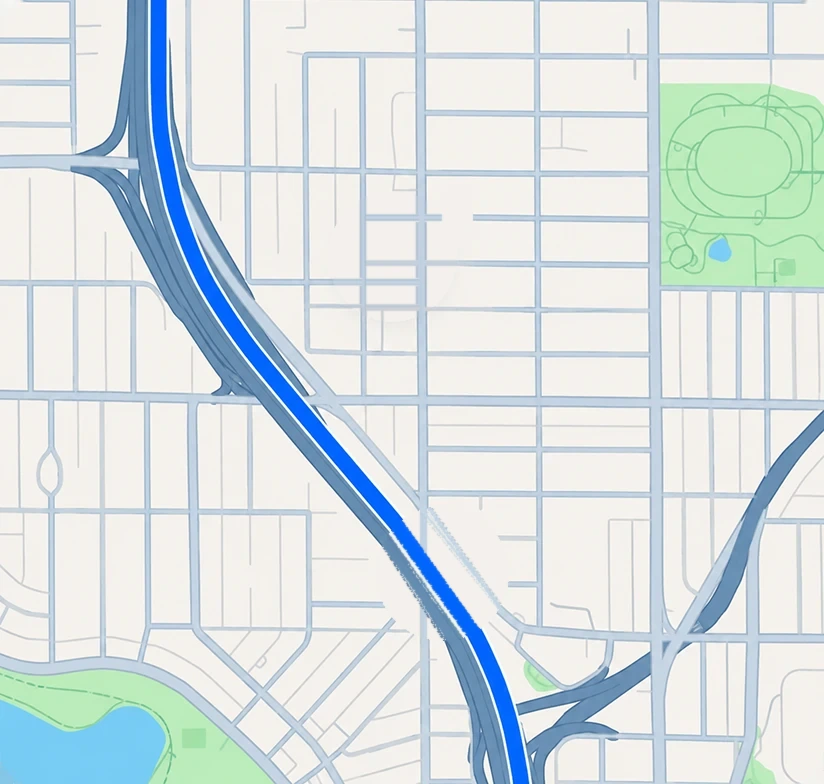
Research showed that people tend to pass their favorite spots to close friends rather than broadcast them, so I made the case for letting people decide who can see their gems. After all, a hidden gem everyone knows about isn’t hidden anymore.
05Keeping storytelling personal
No two travelers remember a road trip the same way, and people we spoke with wanted to curate their own version. So I advocated for individual recaps, letting each person keep what mattered to them instead of merging everyone’s memories into one.
To make each recap feel more personal, I extended Maps’ spatial canvas into storytelling, reimagining the route as a hand-drawn map of memories rather than an AI-generated summary.
06Putting the entire journey on the map
We built natively, reasoning that road trippers would pick up new collaborative features more easily inside a product they already knew. Playing to Google Maps’ strengths, we designed every stage around spatialization, from discovery and exploration on the road to each trip’s personalized story afterward.
- Discover stops along the route
- Find Hidden Gems on the way
- Relive it as a map of memories
I led storyboarding to lay out the full experience end-to-end, and the team refined our flows in Figma before developing a mobile-first prototype on the Google Maps API using Claude Code and Cursor.
Testing
Safety and sentiment weren't enough on their own
We tested early versions on a road trip of our own and in two rounds of concept testing with Gen Z road trippers, before finalizing the concept.
Adding a stop
Safety came at the cost of inclusion. With planning off-limits while driving, the driver felt more like a chauffeur than part of the group.
Hidden Gems
The sentiment landed, but the incentive didn’t. People said a time capsule felt special, but retrieving one felt like high effort with little reward.
“It’s cute, but like respectfully, why would I go out of my way for a few photos?”
Final Product
A road trip mode built for the group, and a recap built for one.
Road Trip Jam
A collaborative mode for Google Maps that keeps the group in sync on the road, with Gemini carrying the cognitive load so friends can focus on the magic.
Starting a Jam
Once everyone’s buckled in, the driver starts the Jam on their phone, and friends scan the QR code on the CarPlay screen to hop on.
Map-based discovery and itinerary-building
Gemini combines the preferences in everyone’s Road Trip Passport, their travel profile in Maps, with their saved places and past reviews into a Travel Blend, a shared taste profile for the group.
The blend powers the Discover feed, which pairs the group’s shared saved list with stops along the route that the whole car will enjoy. Once the group agrees on a stop, it goes into the Shared Itinerary, so everyone’s plan stays in one place.
Adding a stop
Anyone can add or remove a stop from their own seat. Once a decision is locked in, it goes straight to the driver’s navigation and the trip continues without interruption.
Hidden Gems
Hidden Gems from friends only appear when you’re nearby, so discovery stays spontaneous.
You can also leave your own Gems along the way, and choose who gets to find them.
Road Trip Wrapped
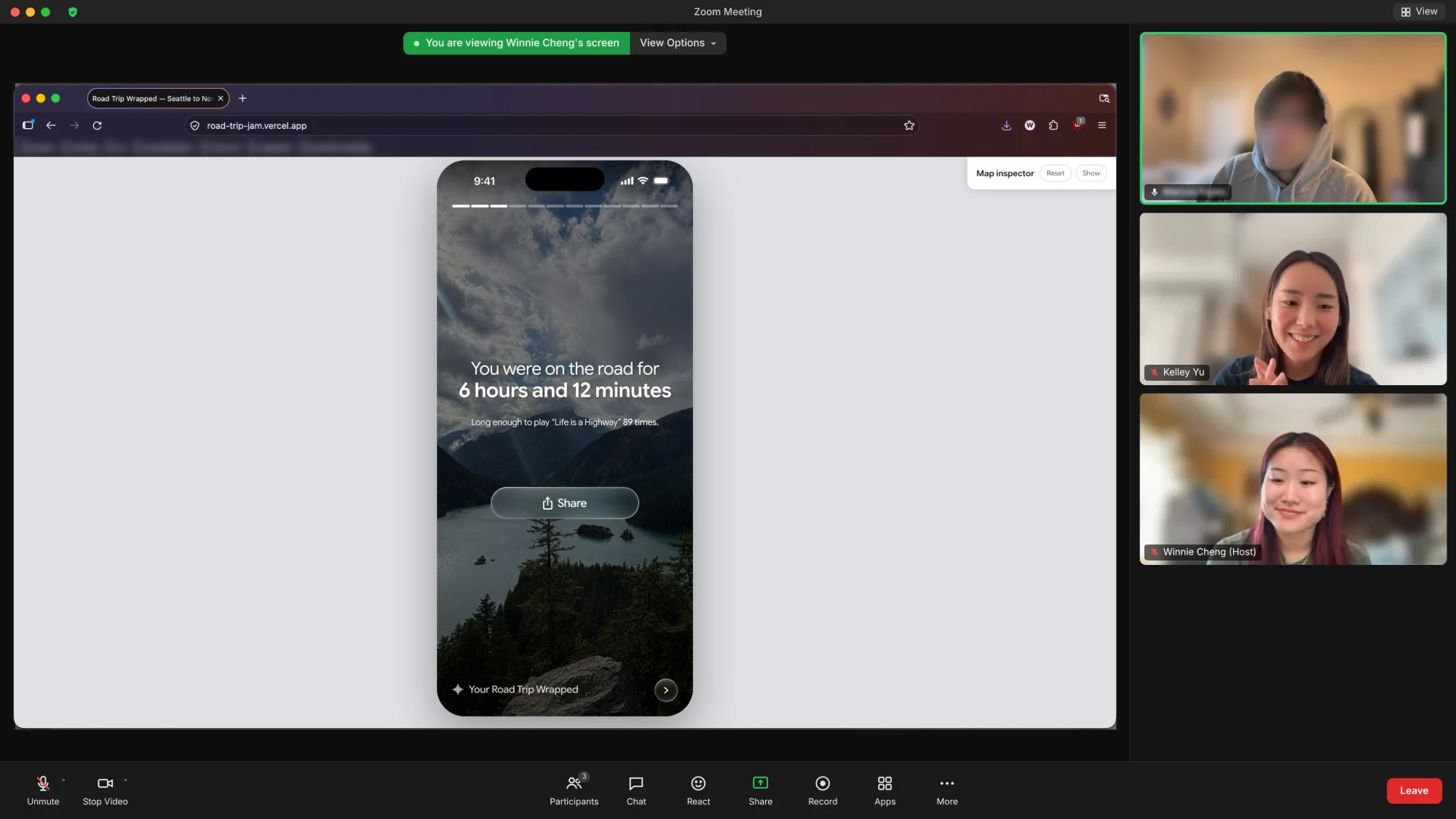
After the trip, your route, trip stats, and chosen photos come together in a personal, shareable recap: a playful, hand-drawn map of the journey.
A 10-photo limit makes every pick count, so each person gets to tell the trip from their own perspective. Captions stay private, holding onto the inside jokes behind each moment.
Past Wrapped keepsakes also live inside your Road Trip Passport, tucked away in your Maps profile, ready to revisit anytime.
Impact
Participants said Road Trip Jam felt less like a planning tool and more like part of the fun!
We shared the finished concept with new participants, then mapped their reactions onto our framework to see where the magic landed.
The Cone (Support & Alignment)
Participants found planning and deciding together in one shared view convenient, and said they wished Jam was a real feature.
The Ice Cream (Human Connection)
Spending less time on decisions, they said, would leave more room for car games and deep conversations. Wrapped reminded them of a “digital scrapbook,” something they’d share on social media and hold onto long after the trip.
“I think it’d be like getting to experience the exact same thing my friend experienced, and I’d be so excited to tell her about it afterwards.”
The Sprinkles (Spontaneous Discovery)
Participants loved the idea of a friend’s Hidden Gem surfacing mid-drive, comparing it to a “scavenger hunt,” and agreed that even a disappointing gem would make a great story.
Our Google partners saw it as new ground for Maps!
“[Bringing users together] is really, to me, novel. We don’t normally think in Google Maps very much about… how people connect.”
Reflections
Ideas outlive their features
Our team always had more ideas than time, and it hit hard every time a feature we loved had to be voted off the island. Early on, I’d designed the Shortlist, a shared list meant to ease the fear of picking a stop that disappoints everyone. It didn’t survive, but its purpose lives on in the Travel Blend.
Getting attached never slowed us down, because once we knew why we loved a feature, we could keep the why and apply it elsewhere.
Designing for restraint helped preserve connection.
I’ll admit—I came in uneasy, picturing Gemini as a dystopian co-pilot in a car full of friends, a bias I knew I’d have to design around. But persistently asking, “Does this need AI?” gave me far clearer direction than asking, “How far can AI go?”
Gemini could have picked everyone’s “best” photos and written their trip stories for them. But, the moments people hold onto are rarely the ones technology generated for them.
Wherever I land next, I’ll carry this with me:
My job was never to use AI to create magic.
It’s to clear the roadblocks so people can make their own magic.
~ thanks for reading :)) ⋆˚✿